We are the most popular brand for Giveaways, WordPress Plugins & WordPress Themes.
Request Themes & Plugins or Get New Updates
Can’t find your favorite WordPress item? Submit a request above, and we’ll add it to our repository!
Important: Extract Before Uploading
After downloading a file from our website, unzip it first. The main zip file may contain additional folders like templates, documentation, or other resources. Ensure you upload the correct file to avoid errors.
How to Install Plugins
How to Install Themes
Request Themes & Plugins or Get New Updates
Can’t find your favorite WordPress item? Submit a request, and we’ll add it to our repository!

Buy Latest Version & Future updates
₹800.00
₹399.00
Join Our Membership to Access All Products
Download this and 12000+ Plugins & Themes as a premium member for only $7.99.
Most medical and cosmetic clinic sites fail for predictable reasons. The pages look fine, but the journey feels disjointed. Before and after galleries are hard to browse, treatment pages read like brochures, and the booking path is buried behind generic menus.
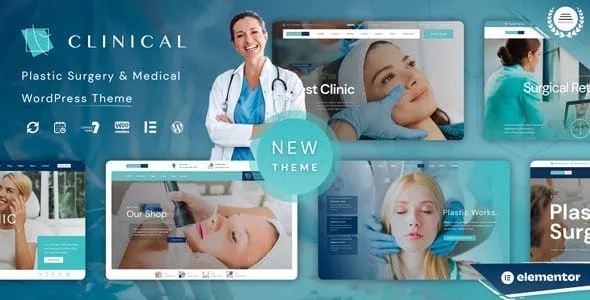
Clinical – Plastic Surgery Theme is built to solve that specific friction. It gives you a layout system that assumes you need treatment detail pages, surgeon profiles, outcome visuals, and a clear conversion path without turning your site into a one page landing page.
I have deployed it on sites where the existing theme was fighting us at every step. The biggest difference is not the visuals. It is the information hierarchy. When you set it up correctly, you can publish content that answers clinical questions, supports trust signals, and still routes visitors toward consultation.
Clinic owners often expect a theme to “come with” compliance, SEO, and conversions. In practice, themes mostly provide structure. The failures happen when the structure is too generic or too rigid.
With plastic surgery sites, the common traps are repeating the same template for every procedure, using galleries that are heavy and unindexed, and burying surgeon credentials in PDFs or image sliders. We have also seen clinics overuse popups and sticky widgets, which can suppress engagement on mobile.
This theme is strongest when you treat it as a framework for building a content library. Procedures, surgeons, FAQs, and outcomes can be organized like a knowledge base, not a set of disconnected marketing pages.
Clinical – Plastic Surgery Theme works best when you lean into its page types and repeatable sections. You can build procedure pages that feel consistent while still being unique enough for indexing and intent separation.
On a well structured setup, we typically map content like this:
Procedure pages that answer candidacy, recovery, risks, and expected outcomes. Surgeon profile pages that support E-E-A-T with experience, credentials, hospital affiliations, and publications. Before and after galleries that are captioned and categorized so they are not just decorative. Consultation and contact flows that are visible but not aggressive.
One thing I like is that you can keep the conversion path present without pushing everything into a single hero section. That matters for Google as well. When the page reads like a real informational resource, it tends to earn better engagement signals and internal linking opportunities.
You can build a clinic site with almost any modern multipurpose theme and a page builder. The problem is that you end up reinventing the same components repeatedly. The “procedure page” becomes a copy paste job. The “doctor page” becomes a generic about layout. Consistency slips as soon as multiple people edit the site.
Clinical – Plastic Surgery Theme is more opinionated. It nudges you toward the sections clinics actually need. That reduces the amount of custom templating and makes it easier to scale content without every page becoming a bespoke design project.
Compared with a generic theme plus a gallery plugin, the biggest win is editorial control. You can keep text, images, and trust elements in a predictable structure. That helps avoid duplicate intent across procedures because each page can carry its own set of modules and supporting details.
Plastic surgery sites are image heavy by nature. That is where performance problems start. I have seen clinics upload 6 to 12 MB “before” images, then wonder why Core Web Vitals tanked and Google stopped crawling deeper pages as often.
The theme itself is only part of the equation, but it influences how many sliders, animations, and gallery scripts you end up running. My advice is to keep galleries simple, avoid autoplay sliders, and serve properly sized images. Use WebP where possible and set consistent aspect ratios so the page does not shift while loading.
If you are building a large procedure library, prioritize internal linking from category hubs and avoid thin tag archives. A theme like this makes it easier to create hub pages that are genuinely useful, which can improve crawl prioritization for the deeper procedure pages.
The most common mistake is importing demo content and leaving the structure intact. The site looks finished, but the content is shallow and duplicated. Google sees near identical pages with swapped procedure names, and indexing becomes inconsistent.
Another issue is treating surgeon profiles as optional. For YMYL adjacent topics, you need clear author and practitioner signals. If the theme provides a profile layout, use it. Add real credentials, years in practice, memberships, and a short “approach to care” section that reads like a human wrote it.
We also ran into navigation bloat on one build. Every procedure became a menu item. The fix was to create procedure hubs and route users through those hubs. It improved usability and reduced internal link dilution.
Clone the site to staging and run updates there. Themes can change global styling and templates. You want a rollback path.
Keep the ZIP intact. Do not unzip and rezip unless you know the package structure is correct. If you are searching for “Clinical – Plastic Surgery Theme download”, use sources you already trust and verify the file before uploading.
Go to Appearance, Themes, Add New, Upload Theme. Upload the ZIP and install. Do not activate yet if you need to confirm required plugins.
After activation, install only what you will use. Extra sliders, icon packs, and form tools can add weight. If a page builder is required, lock your decision early because switching builders later is painful.
If you import, treat it as a layout reference. Replace text blocks immediately. Remove placeholder procedures and rebuild with your own taxonomy and internal links.
Review procedure pages, profile pages, blog posts, and contact pages. Test on mobile for sticky headers, tap targets, and image cropping.
Confirm titles, meta descriptions, canonical behavior, and indexation settings. Then test performance on a few image heavy pages. Fix image sizes before you publish more content.
Yes, as long as your services fit the same content pattern: practitioner profiles, service detail pages, and visual proof. It can also suit dermatology, aesthetics, and dental cosmetic services with minor adjustments.
No. It helps you publish better structured pages, but rankings come from content quality, internal linking, and trust signals. The theme is a foundation, not an SEO strategy.
Give each procedure page a distinct angle. Change the question set, recovery timeline detail, candidacy criteria, and supporting media. Build unique FAQs per procedure and link out to related guides rather than repeating paragraphs.
Use fewer, higher quality cases with captions and context. Compress images, keep consistent dimensions, and avoid stacking multiple heavy sliders on one page. If you have many cases, create category pages and paginate.
It depends on how the theme was packaged. Some builds rely on a builder for the layout modules. If you want to stay close to the block editor, confirm compatibility before committing your content workflow.
Header and footer layout, typography scaling on mobile, and whether your core pages still use the right templates. Also verify that schema or SEO plugin output did not get overridden by theme settings.
Usually yes, but plan for longer strings and different typography needs. Test procedure navigation and appointment CTAs in each language so the layout does not break.
Geotoko is a trusted GPL website for WordPress themes, plugins, Shopify templates, and free giveaways. Download original, secure GPL files with lifetime updates.
All products on Geotoko are fully licensed under the GNU General Public License (GPL) and are independently reviewed for safety and quality.