We are the most popular brand for Giveaways, WordPress Plugins & WordPress Themes.
Request Themes & Plugins or Get New Updates
Can’t find your favorite WordPress item? Submit a request above, and we’ll add it to our repository!
Important: Extract Before Uploading
After downloading a file from our website, unzip it first. The main zip file may contain additional folders like templates, documentation, or other resources. Ensure you upload the correct file to avoid errors.
How to Install Plugins
How to Install Themes
Request Themes & Plugins or Get New Updates
Can’t find your favorite WordPress item? Submit a request, and we’ll add it to our repository!

Buy Latest Version & Future updates
₹500.00
₹199.00
Join Our Membership to Access All Products
Download this and 12000+ Plugins & Themes as a premium member for only $7.99.
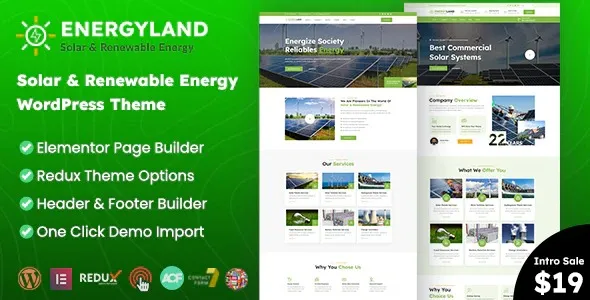
Energyland – Solar & Renewable Energy WordPress Theme is built for solar installers, renewable energy consultants, EV charging providers, and sustainability services that need a site to look credible fast without spending weeks on design decisions. The real win is not the homepage layout. It is the set of prebuilt patterns that make “service business plus lead capture” feel coherent across pages.
I have deployed this theme on sites where the client already had a messy set of pages, mixed icon styles, and three different contact forms. Energyland gave us a consistent visual system and page structure we could standardize around. That matters when you are trying to get pages indexed cleanly and avoid thin, duplicate-intent service pages.
Renewable energy sites tend to fail in predictable ways. They either look like a generic agency template, or they overdo technical detail while burying the quote request path. The other common issue is “project gallery everywhere,” which creates lots of near-duplicate pages that Google treats as low value.
Energyland pushes you toward a clearer hierarchy: services, proof, and conversion. When we used it for a multi-location installer, we could keep location pages focused on local trust signals while keeping service pages focused on intent. That separation helps indexing because each URL can target a distinct purpose instead of competing with siblings.
The theme’s biggest practical benefit is how quickly you can assemble a complete funnel. You can run a visitor from a service overview into a case study, then to a quote form without inventing new layouts for each step.
In real projects, we typically use it to publish:
1) Service pages that do not feel identical. You can vary section order, add different proof blocks, and keep calls to action consistent.
2) Project and case study entries that show outcomes, not just photos. This is where E-E-A-T signals live if you add scope, constraints, and measurable results.
3) Team and company pages that do more than list names. Adding certifications, partner badges, and process steps makes those pages index-worthy rather than ornamental.
Energyland is also a good fit if you plan to pair a content strategy with the theme. Blog posts about incentives, battery sizing, maintenance, and net metering can be internally linked into service pages without the site feeling like two different designs stitched together.
When you use a niche theme, the risk is publishing ten pages that look different visually but say the same thing. I have seen Energyland installs where every service page used the same hero text, the same FAQ block, and the same bullet list. That is a fast way to create internal competition and slow down crawl prioritization on larger sites.
What worked better for us was treating the templates as components, not as finished pages. We kept a consistent structure for navigation and conversion, but we changed the informational center of each page. For example, the “Solar Installation” page focused on assessment and design constraints, while the “Maintenance” page focused on monitoring, cleaning intervals, and warranty boundaries.
If you are building many pages, decide early which page type owns which intent:
Service pages target “what you do” and “how it works.”
Location pages target “where you do it” and local proof.
Case studies target “what happened” and outcomes.
Keeping those roles distinct prevents the theme’s reusable blocks from turning into duplicate content at scale.
Energyland can be made fast, but only if you treat the demo import as a starting point. The demo often brings in heavy images and a lot of decorative assets. On one build, we saw a noticeable improvement just by replacing demo images with properly sized WebP files and removing unused sliders.
Another thing I have run into is overbuilding pages with too many repeating sections. The theme makes it easy to stack blocks, but long pages with multiple carousels and animated counters can increase layout shift and delay interaction. If your primary goal is leads, you usually do not need three separate testimonial components.
My rule of thumb: keep one proof section above the fold, one deeper on the page, and make everything else support clarity. You will get better performance and a cleaner signal for Google about what the page is actually about.
If you are looking for Energyland – Solar & Renewable Energy WordPress Theme download files, treat the process like a production deployment. Most theme issues I fix are not “bad theme” problems. They are version mismatches, missing required plugins, or a demo import done on a live site without a rollback plan.
Create a staging copy of your WordPress site. If you cannot, at least take a full backup of files and database. Theme activation can change menus, widgets, and homepage settings.
In WordPress, go to Appearance, Themes, Add New, Upload Theme. Upload the theme ZIP and activate it. If you hit an upload limit, increase the server limits or upload via SFTP and then activate from the dashboard.
After activation, install the plugins the theme prompts you to add. Do not skip this step. Many “missing layout” issues come from page builder components not being active.
If you use the demo importer, run it on staging and verify: homepage assignment, menu locations, header and footer templates, and global typography. Demo imports can overwrite or duplicate content. We usually import, then immediately delete unused pages and media so the site does not carry dead weight.
Replace demo text early. Leaving placeholder copy in place is not just a branding problem. It can create thin pages that do not deserve indexing. Start with services, contact, and one strong case study.
Confirm that your permalinks are set, your sitemap is generated, and your pages are not accidentally set to noindex. Then test mobile layouts and Core Web Vitals. Theme layouts can look fine on desktop and still break spacing on smaller screens.
Energyland makes sense when you need a polished service business site with clear conversion paths and you want design consistency across many pages. It is also a good match if your team will publish content regularly and you want templates that support structured pages without constant design work.
You may not need it if your site is a simple one-page brochure, or if you already have a lightweight block theme that performs well and you only need a few custom sections. In those cases, switching themes can introduce more moving parts than you gain.
Yes. The layout patterns fit installers (services, projects, quote forms) and consultants (audits, reporting, compliance, ongoing retainers). The main difference is how you structure proof. Installers lean on project outcomes. Consultants lean on process and credentials.
The most common causes are missing required plugins, the wrong homepage not being assigned, or global theme settings not being imported. I also see this when caching is aggressive and the CSS does not regenerate after import.
It can work, but plan your catalog carefully. If the theme is primarily service-oriented, you may need to simplify shop layouts and avoid turning every accessory into a thin product page. Build a few strong product pages and support them with documentation and FAQs.
Yes, but you need a content plan that prevents location pages from becoming duplicates. Use unique local proof, service availability, team presence, and project examples per location. Do not clone the same page and swap only the city name.
Delete unused pages, sample posts, and media you will not keep. Large demo image libraries can slow down the admin area and inflate backups. Keeping only what you actually use makes future maintenance easier.
Vary the informational center of each page. Change the questions you answer, add different proof types, and write unique introductions. Keep the design system consistent, but do not reuse the same section order and headings across every service.
Verify your WordPress and PHP versions, confirm you have enough memory limit for imports, and plan a staging workflow. Most rebuild delays come from trying to install and import directly on production without a rollback path.
Geotoko is a trusted GPL website for WordPress themes, plugins, Shopify templates, and free giveaways. Download original, secure GPL files with lifetime updates.
All products on Geotoko are fully licensed under the GNU General Public License (GPL) and are independently reviewed for safety and quality.