
We are the most popular brand for Giveaways, WordPress Plugins & WordPress Themes.
Request Themes & Plugins or Get New Updates
Can’t find your favorite WordPress item? Submit a request above, and we’ll add it to our repository!
Important: Extract Before Uploading
After downloading a file from our website, unzip it first. The main zip file may contain additional folders like templates, documentation, or other resources. Ensure you upload the correct file to avoid errors.
How to Install Plugins
How to Install Themes
Request Themes & Plugins or Get New Updates
Can’t find your favorite WordPress item? Submit a request, and we’ll add it to our repository!

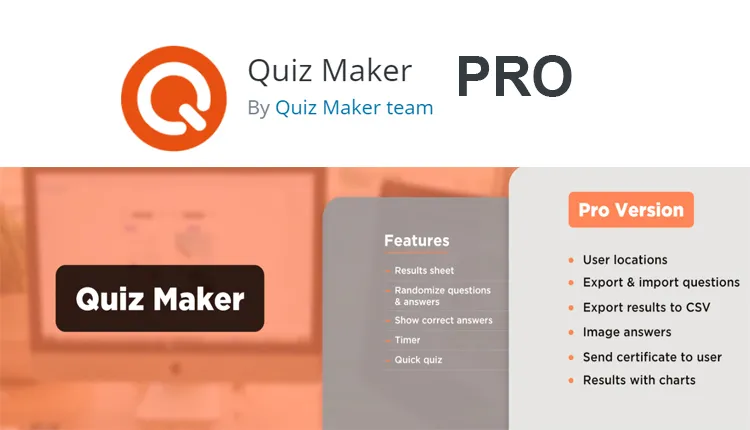
Buy Latest Version & Future updates
₹800.00
₹450.00
Join Our Membership to Access All Products
Download this and 12000+ Plugins & Themes as a premium member for only $7.99.
Creating interactive assessments on WordPress often requires a balance between ease of use and deep logic. Once you download Quiz Maker Pro and activate the addon bundle, the transition from simple ‘radio button’ forms to complex personality quizzes becomes a repeatable workflow.
This setup is ideal for site owners who need to capture leads and segment audiences without the overhead of custom development.
Quizzes look simple on the front end, but the operational headache usually shows up behind the scenes: keeping question banks organized, making results meaningful, and collecting data you can actually use. A basic “form with radio buttons” doesn’t help when you need scoring rules, randomized questions, retakes, time limits, or a clean results experience that fits your content workflow.
In real usage, Quiz Maker Pro + All Addons behaves like a conversion and engagement tool: it’s built to increase time on page, segment visitors through outcomes, capture leads around results, and turn passive readers into measurable actions. The quiz itself is content, but the reason most sites keep it long-term is the marketing workflow around it: funnel entry, segmentation, and follow-up.
The first quiz is easy. The tenth quiz is where most WordPress sites start to break down. Editors duplicate pages, questions drift out of sync, and results become inconsistent because scoring logic is scattered across shortcodes and improvised spreadsheets.
Quiz Maker Pro + All Addons centralizes quiz logic in the dashboard so you can treat quizzes like a reusable asset. Instead of rebuilding the same patterns each time, you define how questions behave, how outcomes are calculated, and what happens after submission. That matters when you have multiple authors, multiple landing pages, or a content calendar that expects quizzes to be published like articles.
The core of a quiz plugin is not the question editor. It’s the rule system: how answers translate into a score or outcome, and how the plugin stores that attempt so the result page is consistent and auditable later.
With the “All Addons” bundle, the intent is to avoid edge-case dead ends. Many sites start with a simple scored quiz and later need one of these: a different results layout, a gating step, deeper reporting, conditional behavior, or an integration that turns a quiz outcome into a contact tag. Addons exist because those needs are not universal, and forcing them into a single default interface often makes the base builder harder to use.
If your quizzes are purely decorative, you may not need the addon bundle. If quizzes are part of lead capture, onboarding, training, or segmentation, the addon set is usually what keeps the system from being replaced six months later.
Quizzes convert well when they are treated as a “micro-commitment” step. The visitor answers a few questions, sees a result that feels specific, and then chooses what to do next. Where sites go wrong is asking for an email too early or presenting results that feel generic.
A practical workflow looks like this:
Quiz Maker Pro + All Addons is useful when you want that workflow to be consistent across multiple quizzes and pages, with results that can be measured instead of guessed.
Most quiz plugins can display questions. The difference shows up when you maintain them.
Question reuse and editing discipline: If you update a question later, you want confidence that the change won’t silently alter the meaning of past results in a way you can’t explain. A structured quiz system helps you manage revisions with fewer “copy/paste and hope” edits.
Scoring and outcomes: Knowledge quizzes need clear scoring rules. Personality quizzes need consistent mapping between answers and outcomes. When those rules live in one place, you can audit them when a client or editor asks why a result changed.
User experience control: Timers, pagination, and retake behavior aren’t “extras” when quizzes are used for training, onboarding, or qualification. They are the guardrails that keep the quiz meaningful.
Data you can work with: If you cannot review attempts, understand completion rates, or see where users drop off, you end up redesigning blindly. A quiz that performs well is usually iterated, not invented perfectly on the first try.
Good fit:
Not the right tool:
Quiz Maker Pro + All Addons, which is the premium plugin package that includes the addon bundle.
Some plugin vendors also publish a separate free “Lite” edition in the WordPress.org directory with a reduced feature set, while reserving advanced logic, integrations, and extended controls for the Pro package.
If you are comparing editions, verify the exact capabilities against the vendor’s own documentation for your specific build, since feature availability can differ by release and licensing plan.
This library entry focuses on downloading the Quiz Maker Pro plugin together with its addon bundle.
In practice, that means you install the main plugin first, then add the addons as separate plugins (or modules) so they can be enabled only when needed. That approach keeps the dashboard cleaner and reduces the chance of enabling features you do not plan to use.
If you are deploying on a production site, test in a staging environment first. Quiz plugins touch front-end scripts, caching behavior, and sometimes email delivery, so it’s better to validate the full submission-to-results flow before publishing.
Quiz pages can be indexable content, but the interactive parts are often script-driven. If you rely on SEO traffic to quizzes, make sure the page still has meaningful static content around the quiz embed: an introduction, who it’s for, and what the result means. That text is what search engines and users understand before the first click.
For performance, treat quizzes like any other interactive widget. If you use aggressive caching or script delay features, validate that answer selection, submission, and results rendering still work. A quiz that fails only for cached visitors is difficult to diagnose after launch because admins often test while logged in.
For analytics, decide what “success” means before you iterate. Completion rate, result distribution, and click-through from results are more actionable than raw pageviews. A quiz can have high traffic and still be ineffective if users abandon it halfway through.
The quiz loads, but buttons don’t respond: This is commonly a JavaScript conflict with a theme script optimizer, a minification plugin, or delayed script execution. Temporarily disable optimization for the quiz page and re-test.
Results look wrong after editing questions: If you change answer values or outcome mapping after a quiz has been live, your historical results interpretation can shift. Keep a habit of duplicating a quiz before major scoring changes, or record your scoring rules in a changelog.
Emails aren’t sending after submission: Many WordPress sites fail outbound mail by default. Test with SMTP configured, then re-check quiz notifications. Don’t assume the quiz plugin is the issue until you confirm WordPress can send mail reliably.
The quiz is visible, but styling is broken: Some themes apply aggressive styles to form elements. Test with a default theme to isolate whether the issue is theme CSS, then add targeted overrides.
Yes. Install and activate the main plugin first, then activate only the addons that match your workflow. Keeping unused addons inactive reduces admin clutter and avoids additional front-end assets in some configurations.
The page containing the quiz can be indexed like any other WordPress page. For search visibility, the surrounding content matters, because the questions and results are often rendered dynamically. Add a clear introduction and context text on the page rather than relying on the quiz UI alone.
Use the plugin’s attempt and retake controls if available in your build, and decide what “repeat” means for your use case (per session, per user account, or per cookie). For logged-in training scenarios, account-based limits are more reliable than cookies.
It can be, as long as you define a workflow for who can edit scoring and outcomes. The biggest multi-editor risk is unreviewed changes to answer weighting or result copy, which can alter the meaning of outcomes across multiple landing pages.
Run at least one full attempt on mobile and desktop, verify the results text matches the expected outcome for a known answer pattern, and confirm any notifications or integrations fire exactly once per submission. Also test while logged out, since caching and script settings often differ for visitors.
Geotoko is a trusted GPL website for WordPress themes, plugins, Shopify templates, and free giveaways. Download original, secure GPL files with lifetime updates.
All products on Geotoko are fully licensed under the GNU General Public License (GPL) and are independently reviewed for safety and quality.